

How a Wake for a Garage Sale Became Trauma-Informed Leadership
By emilie boggis.
The annual Garage Sale was dying. I was a new-ish faith leader sitting around a table with Garage Sale organizers as they bemoaned the amount of work it entailed and the loss of younger, more able-bodied volunteers. Before the meeting, a few organizers pulled me aside to share they were only keeping the Garage Sale alive for Patti, whose very existence seemed dependent on it. In spite of their devotion to Patti, the consensus by the end of the meeting was that this year would be the Garage Sale’s last.
The air felt heavy with sadness. It was tempting - and far more comfortable - to simply move on without acknowledging it. Nevertheless, I somehow intuited what they needed from me as their minister was to help them engage their feelings rather than manage them.
“Tell me what you have loved about the Garage Sale,” I invited. Out poured the stories of meaning and connection. “What will you miss?” Tears ensued. “What won’t you miss?” Laughter prevailed as they rattled off a long list (which included annual book department squabbles). After everyone had left, I realized we had just held a wake for a Garage Sale.
Almost twenty years later, I learned in a workshop on Trauma-Informed Communities that I had (unknowingly) created what social scientists and psychologists call a “nesting ground.” A nesting ground is a structured conversation or forum, ritual, or routine where people can safely process what they are experiencing without threat of being dismissed, corrected, or humiliated. Nesting grounds are “holding environments” for integrating change, loss, and traumatic experiences. Yes, wakes and funerals are nesting grounds!
Comedian Josh Johnson recently stated (in all seriousness) that being anxious is the current American resting state. Johnson listed countless examples of red-flag issues that are considered “normal” these days, several being deep existential crises. Additionally, there are fewer and fewer individuals and institutions Americans trust with their vulnerabilities. [To demonstrate, I invite you to take 30 seconds and write down three people and three spaces where you feel both physically and psychologically safe occupying or sharing a vulnerable issue.]
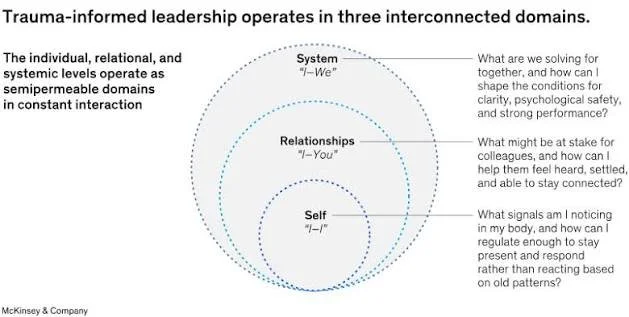
Leading organizations in an anxious world, it becomes essential for us to understand how people, including ourselves, react to anxiety, stress, and trauma. How it shapes people’s thinking and decision-making, how it affects our relationships and community culture. Quite simply, it is often up to the leaders to create psychologically safe environments for our people to convert this resting anxious state into connection, meaning, and resilience. It requires leaders to cultivate awareness in ourselves, in our relationships, and across our communities. McKinsey & Company describes these as three interconnected domains:
The I-I relationship: What signals am I noticing in my body, and how can I regulate enough to stay present and respond rather than react in old patterns?
The I-You relationship: What might be at stake for colleagues and staff, and how can I help them feel heard, settled, and able to stay connected?
The I-We relationship: What are we solving for together (mission, goals, change), and how can I shape the conditions for clarity, psychological safety, and strong performance?
Whether the institutions we lead are spiritual, secular, or somewhere in between, the leader of the 21st century needs to be trauma-informed.
On October 28-29, LeaderWise’s workshop, The Trauma-Informed Leader, will focus first on you: How is trauma informing and influencing your leadership? On day two, our facilitators will provide concepts, tools, and space for you to learn how to foster and lead trauma-informed, resilience-based communities. Open for all leaders with specific focus on values-based and faith-based leaders. Register for your spot and invite your colleagues, staff, and volunteer leaders here.
