
Speaking of Transitions . . .
By Mary Kay DuChene.
It was a blustery day, first of February, when we, the synod staff of the ELCA Southeastern MN Synod, gathered for a 2-day retreat. Bishop Delzer had finally formed the staff team he wanted for his tenure as bishop, and decided that a retreat to begin to bond the team and set our direction was warranted. As we sat in the living room of the retreat house, he began devotions. After offering a reading, he reflected extemporaneously, “Today was supposed to be the first day of my retirement. But I accepted this call to be bishop. I am committed to this call, and I will be a 1-term bishop...” With this surprise opening, we began to discern what we as a team were called to accomplish during our time together. We walked away from that retreat with a big goal, and a mantra for our tenure together.
I learned what a gift it was to have our end date as a stake in the ground, even though it was years away. I saw the trust we built by having the bishop provide such clarity about the future. I experienced the passion and commitment from a team that discerned together and then got behind the goal and went to work. Our days were numbered—we had work to do.
Fast forward many years to this era of my time with LeaderWise—my colleague Mark Sundby and I began talking about our respective retirement plans. He and I are the same age, and we knew we wanted the kind of clarity and purpose in our transition that Bishop Delzer curated into his. In 2022, we announced that we’d both retire on December 31, 2027, and we’ve been working on succession planning around that event ever since. We’ve been open with our staff, and we’ve actively discussed plans for continuity of leadership with our colleagues and our board. It has been a blessing.
When LeaderWise consultants are out in the world working with organizations who are facing conflict, trauma, a past misconduct, or change of some sort, we often find we’re teaching about the emotional process of transition. William Bridges provides a simple but powerful framework to understand transition as an emotional process.[1] The model has 3 seemingly simple, yet deeply complex, phases: the ENDING (the change event, the emotional process of letting go, attending to grief), the NEUTRAL ZONE (a time of chaos and disruption, but also a time of experimentation and innovation, a time of adaptive leadership and change), and the NEW BEGINNING (the time when one is emotionally ready to begin the new way of being). All people and organizations in transition go through the phases of this model. I am here now, and so is LeaderWise, because I’ve changed my retirement date. I’ve moved it up to May 31, 2026!
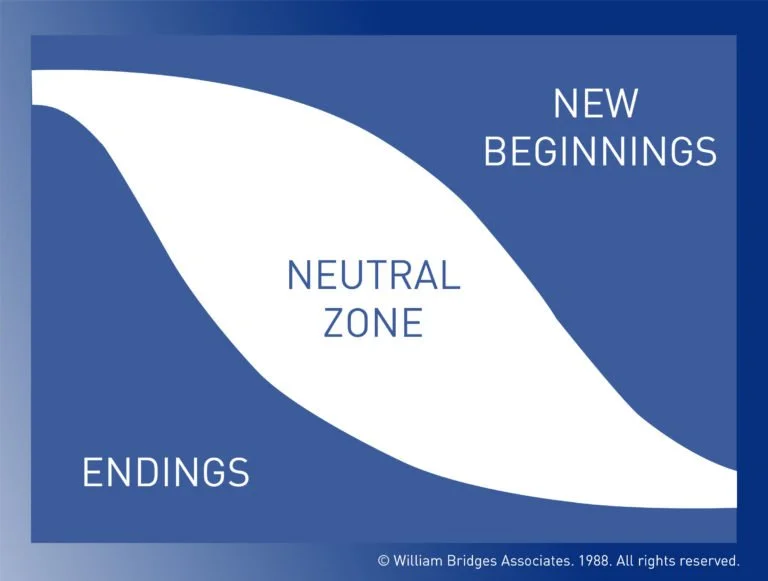
Some people worry that making an announcement about a future retirement date will commit them to something they’ll change their mind about or, worse, that it will make them a “lame duck.” It doesn’t have to be that way. Leading adaptively requires that we learn as we go, and we open ourselves to making shifts in response to that learning. It’s in this vein that I have recently shared with my leadership team colleagues that I’ve discerned a date change for my retirement (a full 18 months sooner than previously planned). And so we began a transition cycle à la William Bridges in a real way. In 2022, it was easy to ignore a retirement date 5 years in the future (even though it was publicly announced!). Fast forward 3 years, bring the retirement date in, and all of a sudden I am, and we are, beginning the emotional process of transition.
Transitions are emotionally complicated, holding within them the paradox of the “both and.” I am fully committed to being here until I’m not. I’m excited about the next phase of life. There is grief for me in letting go of role and responsibility in favor of executing a succession plan that’s in LeaderWise’s best interest (see last week’s article). There’s wondering whether I will be happy retiring. There’s grief in recognizing I’ll miss my colleagues, the work, and the client relationships I’ve built over the years. There’s joy in knowing I’ll have more time for grandchildren and adult children, husband and dogs. All of it is real. All of it is part of the emotional process of transition.
I am excited for LeaderWise’s new chapter, and I am excited for my own. As we all move through this transition together, we will process, learn, and grow together; just like we have always done. It’s part of LeaderWise’s Usness—a difficult-to-define word that describes our culture of togetherness.
My hope and prayer is that by sharing this with you, you too can find your way to creating intentional transitions (and LeaderWise is here to help you with that if you need), no matter the catalyst. As my spiritual director says, “it’s a good hard.” May it be so with you.
[1] William Bridges, Managing Transitions: Making the Most of Change
If you decide to purchase the book through this link, LeaderWise will earn a nominal affiliate fee. Proceeds will support LeaderWise programs and mission.
